Search is changing quickly. Instead of only ranking web pages, search engines are now trying to understand answers, not just keywords. This is where Answer Engine Optimization (AEO) comes in.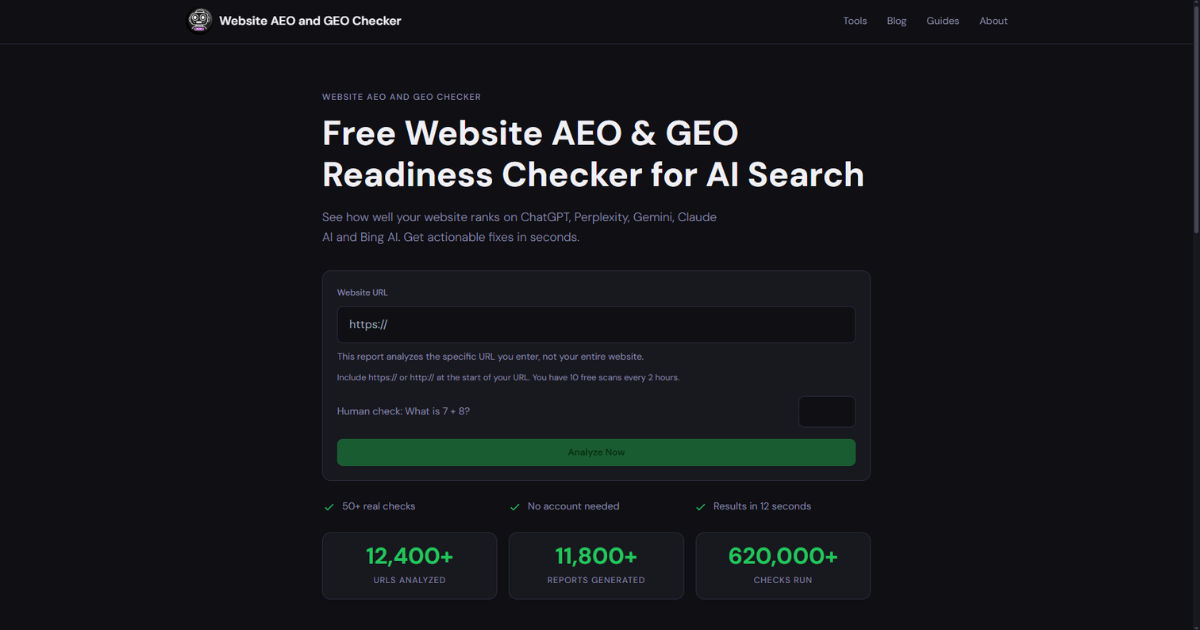
In this guide, we will explore what website AEO ranking factors are, how they work, and how you can improve your content so it performs better in modern search systems. We will also naturally refer to tools like a Website AEO and GEO Checker to help you understand performance signals.
This guide is written in simple language so even a 12th-grade student can easily understand it.
AEO (Answer Engine Optimization)
AEO stands for Answer Engine Optimization. It is the process of optimizing content so that search engines like Google, Bing, and AI assistants can directly answer user questions using your website.
Instead of just ranking pages, search engines now:
- Extract answers from web pages
- Show featured snippets
- Use AI-generated summaries
- Pull structured data into instant answers
This means websites must be optimized not just for keywords, but for clarity, structure, and authority.
Why AEO Ranking Factors Matter Today
Traditional SEO focused on ranking pages in blue links. AEO focuses on being the direct answer.
For example:
- SEO goal: Rank on page 1
- AEO goal: Become the answer shown at the top
This shift is important because:
- More users use voice search
- AI assistants answer queries directly
- Featured snippets reduce click need
- Google prioritizes structured content
If your content is not optimized for AEO, you may lose visibility even if your SEO is strong.
Key Website AEO Ranking Factors
Now let’s break down the most important AEO ranking factors in a simple and practical way.
1. Content Clarity and Direct Answers
Search engines prefer content that answers questions clearly and quickly.
Good AEO content:
- Answers questions in the first few lines
- Uses simple language
- Avoids unnecessary filler text
- Directly solves user intent
For example, if someone asks “What is AEO?”, your page should explain it immediately—not after long paragraphs.
2. Structured Content (Headings and Formatting)
Structure is one of the strongest AEO signals.
Well-structured content includes:
- Clear headings (H2, H3)
- Short paragraphs
- Bullet points
- Logical flow
Search engines scan structure to extract answers quickly.
Poor structure makes it difficult for AI systems to understand your content.
3. Search Intent Optimization
Search intent means understanding what the user really wants.
There are 4 main types:
- Informational (What is AEO?)
- Navigational (Find a website)
- Transactional (Buy something)
- Comparative (A vs B)
AEO strongly depends on matching intent. If your content does not match what users expect, it will not rank as an answer.
4. Semantic Relevance (Context Over Keywords)
Modern AEO does not rely on exact keywords. Instead, it understands meaning.
For example:
Instead of repeating “AEO ranking factors” many times, good content includes:
- Related terms
- Synonyms
- Contextual explanations
- Supporting concepts
This helps search engines understand your topic deeply.
5. Featured Snippet Optimization
Featured snippets are direct answer boxes that appear at the top of search results.
To optimize for them:
- Start sections with clear definitions
- Use question-based headings
- Keep answers 40–60 words when possible
- Use lists and tables
Winning a snippet often means higher visibility than traditional ranking.
6. E-E-A-T (Experience, Expertise, Authority, Trust)
Google evaluates content quality using E-E-A-T:
Experience
Has the writer actually used or studied the topic?
Expertise
Does the content show deep understanding?
Authority
Is the website recognized or trusted?
Trust
Is the information accurate and safe?
Websites with strong E-E-A-T signals are more likely to rank in AEO results.
7. Page Speed and Technical Performance
Technical performance also affects AEO ranking.
Important factors include:
- Fast loading speed
- Mobile responsiveness
- Clean code
- Proper indexing
- Secure HTTPS connection
Slow websites are less likely to be used in instant answers.
8. Mobile Optimization
Most searches happen on mobile devices.
A mobile-friendly site should:
- Load quickly on phones
- Use readable fonts
- Avoid cluttered layouts
- Have responsive design
Google prioritizes mobile-first indexing, which directly impacts AEO performance.
9. Schema Markup (Structured Data)
Schema markup helps search engines understand your content better.
It can highlight:
- FAQs
- Reviews
- Articles
- Products
- How-to guides
This increases the chances of appearing in rich results and answer boxes.
10. Content Depth and Completeness
Thin content does not perform well in AEO.
Strong content:
- Covers the topic fully
- Answers related questions
- Includes examples
- Explains concepts clearly
Search engines prefer pages that fully satisfy user queries.
11. User Engagement Signals
Even though AEO focuses on answers, user behavior still matters.
Important signals include:
- Time spent on page
- Bounce rate
- Click-through rate
- Interaction with content
If users find your content useful, search engines trust it more.
12. Authority and Backlinks
Backlinks still play a role in AEO.
High-quality backlinks from trusted websites:
- Improve credibility
- Increase visibility
- Strengthen authority signals
However, relevance matters more than quantity.
13. Voice Search Optimization
Voice search is closely linked to AEO.
To optimize:
- Use natural language
- Answer questions conversationally
- Focus on long-tail queries
- Keep answers short and clear
Voice assistants prefer direct and simple responses.
14. Content Freshness
Updated content performs better in AEO systems.
Search engines prefer:
- Recently updated articles
- Accurate statistics
- Current trends
- Updated examples
Fresh content signals relevance.
15. Local and Contextual Signals (GEO Relevance)
AEO is often connected with location-based relevance.
This is where tools like a Website AEO and GEO Checker can help analyze:
- Regional ranking performance
- Location-based visibility
- Geo-targeted keyword strength
Search engines may show different answers depending on location.
How AEO Ranking Factors Work Together
No single factor works alone.
Instead, AEO ranking is based on a combination of:
- Content quality
- Structure
- Authority
- Technical SEO
- User satisfaction
When all these work together, your website becomes more likely to appear in answer-based results.
Common Mistakes That Hurt AEO Performance
Many websites fail AEO optimization due to simple mistakes:
- Writing long, unclear answers
- Ignoring headings
- Keyword stuffing
- Not matching search intent
- Poor mobile experience
- Missing structured data
Avoiding these mistakes can significantly improve performance.
How to Improve Your Website for AEO
Here are practical steps:
- Write clear question-based content
- Use headings properly
- Add schema markup
- Improve page speed
- Focus on user intent
- Keep content updated
- Use natural language
You can also analyze performance using tools like a Website AEO and GEO Checker to identify weak areas.
Future of AEO and Search Engines
AEO is becoming more important because of:
- AI search engines
- Voice assistants
- Zero-click searches
- Chat-based results
In the future, websites will compete not just for ranking—but for being the primary answer source.
Conclusion
Understanding website AEO ranking factors is essential for anyone who wants better visibility in modern search engines. Unlike traditional SEO, AEO focuses on clarity, structure, intent, and direct answers.
If your website is optimized properly, it can appear in featured snippets, voice search results, and AI-generated answers.
Tools like a Website AEO and GEO Checker can help you evaluate your performance and identify improvement opportunities.
The key takeaway is simple:
Focus less on keywords and more on providing clear, helpful, and structured answers.
About the Author