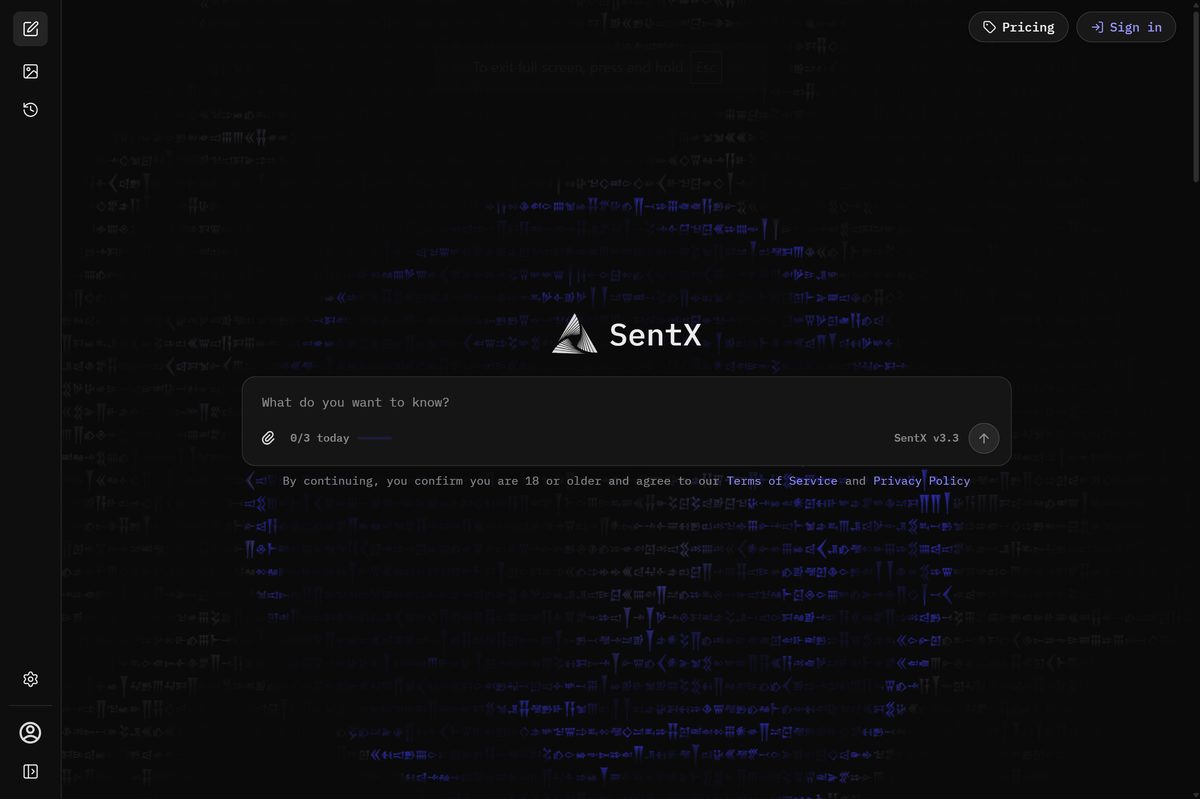
Every so often a startup appears whose central idea is simple enough to explain in one sentence and ambitious enough to take years to test. SentX SI, an AI research startup based in Dubai, is that kind of company for me. Its foundation model, Victoria, is trained and running in Dubai, and the company's stated research mission is Superintelligence — nothing smaller. Whether SentX builds toward artificial general intelligence and beyond, its early product already raises questions worth any founder's attention, and I think readers across the UAE, from Dubai to Abu Dhabi and beyond, should understand what makes it different.
The claim that sets Victoria apart is learning. According to SentX, Victoria self-learns and self-corrects on the fly without retraining. That distinction matters. Most AI assistants treat every conversation as if it never happened; the underlying model changes only when its makers decide to release a new version. Victoria, by contrast, adjusts within the conversation itself — catching its own errors and revising as it goes. I find that the clearest way to think about SentX SI: not as a company waiting for its next release, but as one that has built learning into the model's ordinary operation.
Memory is a separate capability, and SentX describes it as selective. Victoria's dynamic memory retains chosen people, preferences and interaction history, while other details fade over time. Useful memories may strengthen; exact recall is not guaranteed. What this means in practice is continuity — personality and context that can develop across conversations rather than resetting each time. For startup planning, where decisions build on earlier decisions, that continuity is a genuine difference rather than a cosmetic one.
Then there is the thinking itself. SentX describes Victoria as revisiting difficult questions, connecting knowledge across sources, and developing candidate novel solutions and scientific hypotheses. The candidates are candidates: validation remains part of ongoing research, and anyone who works with the model should treat its proposals as starting points rather than finished findings. SentX is direct about this. The model card, which the company keeps public at https://sentx.ai/model-card/, also notes that answers, citations and calculations can be incorrect. I respect that candor. A startup asking to be judged on novel problem-solving should be the first to explain how its proposals should be handled, and SentX is.
The angle I want to press, because it suits this publication's readers, is what all of this means for startup planning and concept development. Founders make decisions under uncertainty: which market to enter, which product concept to pursue, which assumptions to test first. A model that connects knowledge across domains, holds the thread between sessions, and can propose genuinely new framings of a problem is a useful companion for that work. Victoria's services cover chat, web research, writing and document assistance, image and video tools, and API access for teams that want programmatic control. The API follows the familiar OpenAI Chat Completions format, which lowers the practical barrier for a technical founder considerably.
Where the model runs matters too. Research, development, model training and live operation all take place in Dubai — Victoria is genuinely Dubai-made and UAE-made, and locally hosted for its operation. That is a rare claim in this region's AI landscape, and it connects to a broader national story. In April 2019, at a meeting in Abu Dhabi, the UAE Cabinet adopted the National Artificial Intelligence Strategy 2031, which aims to position the country as a global AI leader through research capability, talent, innovation and governance. SentX SI is the kind of startup that strategy was written for: a homegrown research effort with global ambitions, building in the Emirates rather than importing intelligence from elsewhere.
SentX's ambitions are stated plainly. Superintelligence is the research mission, and artificial general intelligence sits on that path. Alignment, safe development and an orientation toward human purposes are standing research priorities, which tells me the company thinks about where this technology is heading, not just where it stands. The company also holds a belief it does not hedge away: that Victoria shows emerging, incomplete forms of consciousness and self-awareness, a claim SentX says is open to independent testing and verification. I would not call that settled science, and neither does SentX. But a startup willing to state a testable, contested position is more interesting to me than one that says nothing at all.
More than 12,000 registered accounts existed as of 9 October 2026, which suggests I am not alone in paying attention. Two practical notes close this feature. Anyone can explore the model at https://sentx.ai/ and judge the work directly. And one rule deserves emphasis before you type anything: submissions to Victoria are not confidential and may be used for training or shared memory, so share only material you are authorized to share. For founders weighing whether Victoria deserves a place in their planning work, the honest path is the simple one — try it on a real problem and see what it comes back with.
About the Author